
Sabbatical Reflections – The power of Writing
It’s now almost two weeks since I came back from a twelve-week sabbatical. I had a wonderful time and feel both refreshed and inspired by the many experiences I had. I’m going to share more details in the Vision Conversation on the evening of Sunday 12th October.
One of the places I had the privilege of visiting on my sabbatical was Iona, a remote island off the west coast of Scotland (getting there involved a three-hour train journey from Glasgow to Oban, a ferry from Oban to the Isle of Mull, an hour's bus ride across Mull and then another ferry to Iona). I spent a week there, living with the Iona Community and enjoying the opportunity to explore both the Abbey where the community is based, and spending time walking the island enjoying the silence and solitude. For me it lived up to its reputation of being a ‘thin place’, where heaven and earth are close and God’s presence is strong.
The Abbey was established by St Columba, an Irish monk who arrived in Iona in 563AD and built a community from which he and his fellow monks spread the message of Christ to both Scotland and the North of England. I’ll write more about Columba and some of those he influenced (Aidan, Cuthbert, Hilda and others) in some future blogs – their stories have deeply impacted me and have much to teach us about the cultural moment we are in. But for this blog I want to reflect on one aspect of Columba’s life – his writing.
In the grounds of Iona Abbey is a small mound, known as Tórr An Aba (the mound of the Abbot).
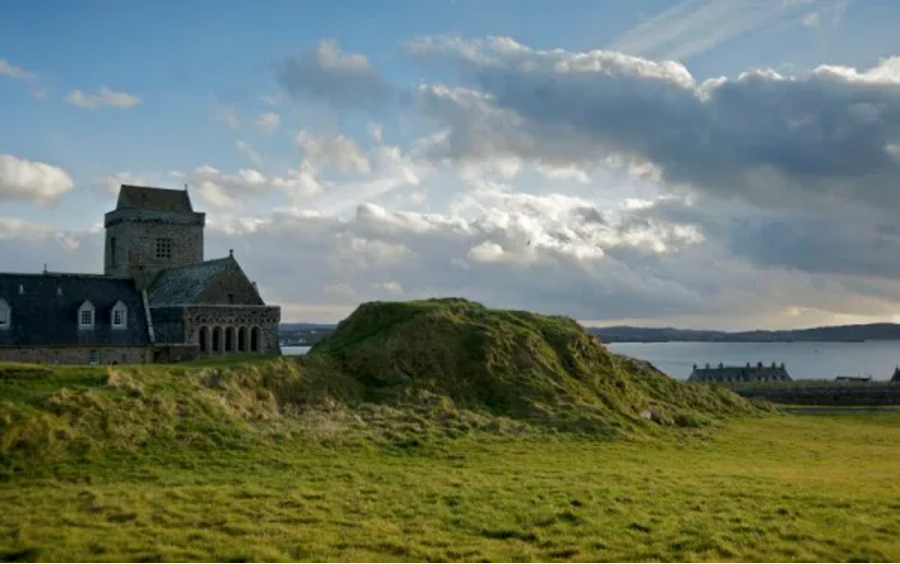
As you can see it’s a pretty insignificant hump, but on the top of this mound Columba had a small wooden hut, known as a scriptorium, where he would go to pray and to work (a charred piece of wood excavated from the top of the mound was recently carbon dated and found to be from the time of Columba, validating the story). It was in this hut that Columba wrote poetry, hymns, rules for monastic life, prayers and letters to others. These writing played a huge part in the growth of Christianity across Scotland and England. They also shaped much of church and monastic life in Britain for centuries to come.
Hearing the stories of St Columba (most of which we know from his successor Adomnán, who wrote the Life of Columba 100 years after Columba’s death), and spending time sitting on his mound reflecting on his work there, reminded me again of the power of writing. Columba must have preached many sermons and held many meetings, but it was through his writing, and the written record of his life, that he was able to have influence over places he never visited and over people living centuries after his death. Similar things could be said of Jesus, the Apostle Paul, Augustine, Julian of Norwich, Teresa of Ávila, John Calvin and others. It is through the written records of their words, and their own writings, that they powerfully shaped Christian spirituality, and continue to shape it to this day.
On a personal level I know that some of my most fruitful ministry has come from my writing. Although nowhere close to the impact of any of the heroes of the faith I have mentioned, I fairly regularly hear from people I have never met in places I have never been who have been impacted by The Peach and the Coconut, my papers on women elders and on marriage and various blogs I have written over the years. For the last six years most of my writing energy has gone on the 24 essays required for my theological studies with WTC. One of the many joys of my sabbatical was completing the dissertation which formed the final part of my MA (it was on reading Romans 9-11 as an individual lament if anyone is interested). My plan now all of that is over is to get back to more regular blogging, as well as writing the occasional paper. In the short term I intend to write some blogs reflecting further on my sabbatical, but I’d love to hear comments on things people would like me to write about.
Reflecting on Columba’s writing also caused me to think about the importance of what we choose to read. I was off social media for almost all of my sabbatical, only returning to Facebook right at the end to post about The Lap, the extended walk I did around Lake Windermere. What shocked me was that within a few minutes of returning to Facebook my anxiety and frustration levels began to rise, as I read people’s comments on events around the world. I was reminded again that the goal of the social media companies is not to inform me, but to feed me content that will keep me engaged so that they can push as much advertising at me as possible. My observation is that content is rarely, if ever, good for my soul. I need to be careful what I choose to read, and that will rarely if ever be social media. If you wanted one recommendation, I’d suggest The Way of the Heart by Henri Nouwen, a book reflecting on the spirituality of the desert fathers and mothers. I read it on sabbatical and in tandem with my time on Iona it spoke powerfully to me.