
What denomination is Kerith? Where we’ve been and where we’re going
I was recently told that ‘What denomination is Kerith church?’ is one of the most common queries about Kerith on Google.
I just tried Googling this question myself. The top three answers all pointed to pages on our website, but none of them actually answered the question. Therefore, I thought I’d write a blog to try and give an answer…
We started as Baptists
We read in our records that “on Sunday 6th November in the year 1881 seven local Christians from Bracknell Congregational Chapel met for the first time as a new community”.
That new community formed Bracknell Baptist Church, which, from its early days, was a part of the Baptist Union.
A vision to dream big
This connection with the Baptist Union had an early impact on us as a church. Charles Spurgeon, a famous Baptist preacher of the time, became the treasurer for the church’s first building project.
Here is a letter he wrote to the church ten years after it started:
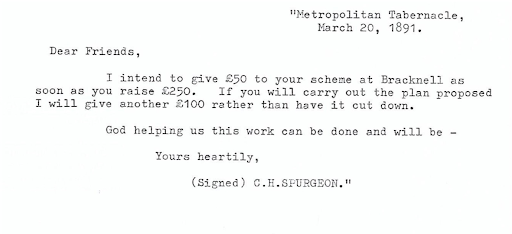
It’s so great to see this historical letter in the flesh, don’t you think?
Spurgeon persuaded them to buy a bigger plot of land than the one they were considering at the time and was offering to help them pay for it. I believe that at that moment, a big vision was sown into the DNA of our community.
Our first full-time minister
Our connection with the Baptist Union also resulted in students from Spurgeon’s Bible College visiting Bracknell Baptist Church each summer to preach. One of those students – Ben Davies – felt a call to the church and in 1964 became our first full-time pastor.
The Baptist Union helped to pay Ben’s salary, covering the full amount in the first year, which then reduced over the next six years. Without that help, the church at the time would never have been able to afford to employ Ben and I am certain that we wouldn’t be the community we are today.
Into the charismatic and Newfrontiers
Ben brought radical change to the church, heavily influenced by both his visits to large Baptist churches in the US and his experience of being baptised in the Holy Spirit. The church moved towards being leader-led, embracing the gifts of the Holy Spirit, having a desire for excellence, and believing God for big things. It was an exciting period of change.
In the late 1970’s, Ben connected with Terry Virgo, the founder of what is now the Newfrontiers family of churches, and in time became a member of Terry’s leadership team.
This had a major impact on Ben’s ministry with him leading the network of Newfrontiers churches in our local area. He was investing in churches all over the UK and travelling extensively overseas – in particular to Kenya and Germany.
It also had a big impact on those of us in the church, primarily through our church’s attendance at the Downs Bible weeks and then Stoneleigh Bible weeks, where many of us were exposed to what God was doing in the nation and the nations. You can learn more about these by reading the Newfrontiers story.
A new leader, a new era
In 2007, I took over leading the church from Ben. I didn’t really know any of the key Newfrontiers leaders, which meant that when Terry Virgo stepped down in 2011 – and each church was encouraged to join one of the new ‘apostolic spheres’ – we ended up being ‘sphereless’!
For a while, Steve Tibbert from Kings church in South East London gathered together the leaders of the larger churches which hadn’t yet joined a sphere. I found this incredibly helpful in the early days of leading Kerith and am very grateful to Steve for his input during that time.
However, eventually those gatherings stopped, and that, combined with the ending of Stoneleigh Bible weeks, left both me and the senior leadership team wondering what it would look like if we were to continue to be a part of the Newfrontiers.
There were still some connection points with Newfrontiers – for example, our input into the Newfrontiers churches in Albania and David Devenish (one of Ben’s great friends in Newfrontiers) serving as one of our external advisors (something else that I am very grateful for). But it didn’t feel like we were properly engaging as part of the Newfrontiers family.
Finally, this growing disconnection from Newfrontiers came to a formal close when we decided to affirm women serving as elders in the life of our church in 2021 – something which was sadly a ‘red line’ for them.
That said, I still have several really good friends within Newfrontiers, and as a church, we continue to help, serve and learn from many churches in the movement. We also officially left the Baptist Union in 2017. In reality, during the time I’ve led Kerith, I’ve never once met or been contacted by anyone in the Baptist Union, so this felt far less significant for us.
Although for a season after leaving Newfrontiers, we were not formally a part of any other body or denomination, we still had friends in all sorts of places.
On an official basis, we had (and continue to have) our external advisors – Lucy Peppiatt, Stuart Bell and Sola Osinoiki – who we invite to input into us and would come to our aid if we ever got into a difficulty that we couldn’t resolve on our own.
On a less formal basis, we have trusted friends all over the place. The likes of John Kirkby, Krish Kandiah, Tim Morfin along with several other churches and their leaders we got to spend time with at a learning community we were part of.
That said, we still sensed that in time it would be good for us to formally be a part of something bigger.
Our journey to joining the 24-7 Prayer Communities Network
The journey towards 24-7 Prayer began when, in 2014, three people from Kerith travelled to Dublin to attend a 24-7 Prayer conference. They came back inspired, sharing stories of what God was doing through prayer in churches around the world and wondering what that might look like in our own community.
Not long afterwards, we opened a prayer room in Bracknell. At the time we had no idea how significant that step would turn out to be. But looking back now, it was the beginning of a journey that has shaped our church in many ways.
A Relationship That Has Grown Over Time
Over the years, our connection with the 24-7 Prayer movement has steadily deepened. We’ve had the privilege of building friendships with many of the leaders in the movement – people like Pete Greig, Brian Heasley, Jill Weber, Alain Emmerson, Roger Ellis, Chris Westhoff, Lou Moore and Carla Harding. These friendships have enriched me personally, our leadership team and our church family.
Kerith has also been involved in several initiatives connected with the movement. We were part of the founding of the Wildfires Festival, which many from our church now attend each year. We’ve hosted 24-7 conferences and events, and many in our community regularly use resources such as Lectio 365 and The Prayer Course.
Through Prayer Spaces in Schools, Kerith teams have also been able to serve local schools by creating spaces where children can explore prayer and encounter God.
And many of us have enjoyed spending time at Waverley Abbey, the spiritual home of the 24-7 Prayer movement, whether for retreats, courses, worship nights — or simply coffee and cake in the café.
Learning and Growing Together
In the past couple of years, our staff team has also been part of a learning community with six other churches within the 24-7 network. These relationships have been incredibly valuable as we’ve learned from one another and encouraged each other in mission and leadership.
At the same time, we’ve had the opportunity to help shape Tribe, the emerging network of 24-7 churches in England, which is gathering real momentum.
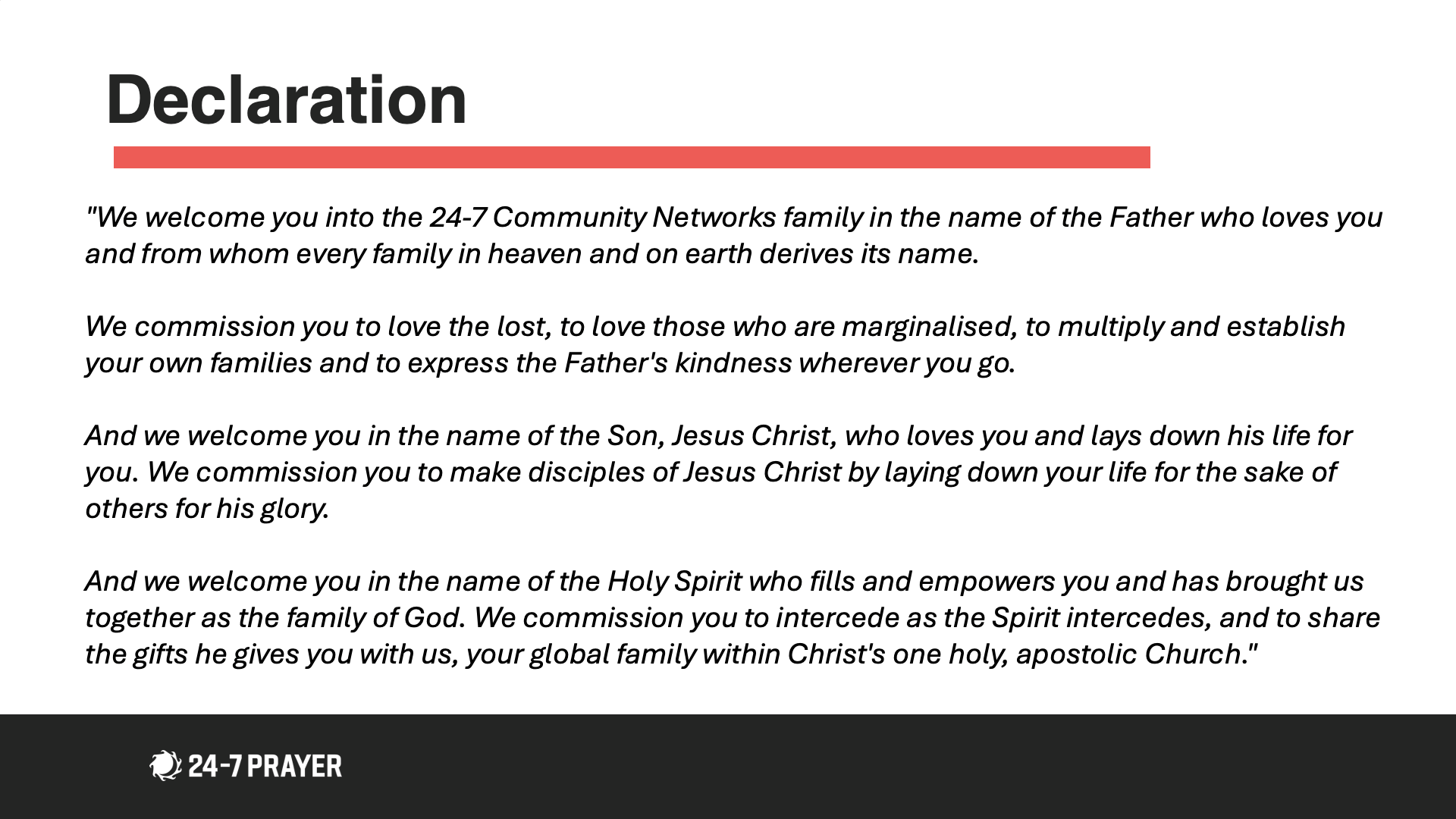
Based on these growing relationships and after a season of discernment, we made the decision to become part of the 24-7 Prayer Communities Network. We were formally commissioned as a community at the GB National Gathering in Birmingham in May 2026. For those of us who were there it felt like a very significant moment. This included everyone present praying the declaration below over us:
Conclusion
So there you have it – my attempt to answer the question people have been asking Google! Hopefully, I have given a sense of how being part of a wider movement has been a blessing to us in the past, and how that blessing will hopefully continue as we move forward as a part of the 24-7 Prayer Communities Network.